


Since its beginning, total knee replacement surgeries have advanced significantly. Innovation was always required to meet the demands of precise implant location and alignment. The efficacy of this treatment has significantly enhanced due to several advancements in surgical supplies, tools, and methods. Today, surgeries can be performed with robotic assistance, a new stage of development. And when it comes to cutting-edge innovations in technology, robotics are promising a better hope for tomorrow.
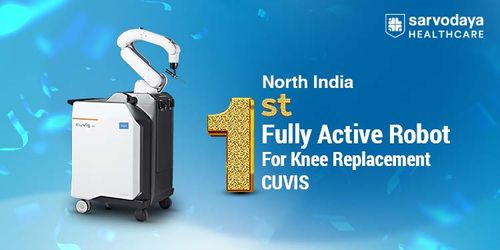
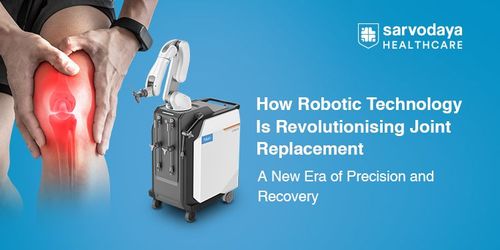
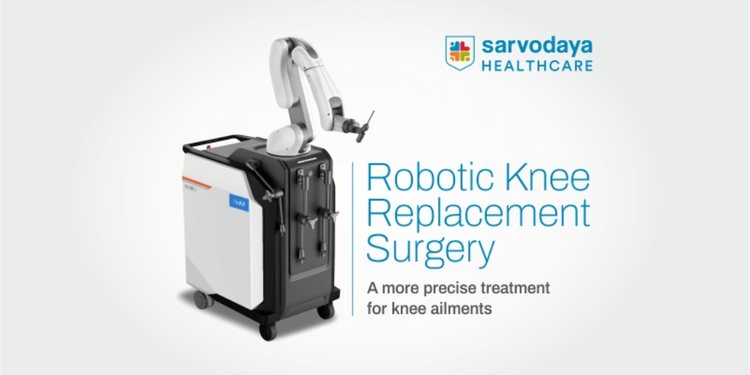
Sarvodaya Hospital is once again ready to provide patients with the greatest surgical outcomes in India with the help of NORTH INDIA'S FIRST FULLY ACTIVE ROBOT (CUVIS) FOR JOINT REPLACEMENT SURGERY.
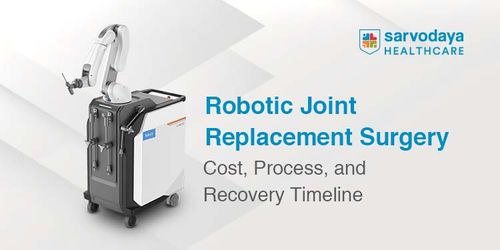
The CUVIS Fully Active Robotic offers better outcomes for knee replacement surgeries. With maximum accuracy and the chance for mid-course correction due to continuous input, it has significantly enhanced the procedure, reducing stress for both doctors and patients.
The 3Ps are the foundation of the robotic knee replacement procedure:
Pre-Planning: By using 3D images, surgeons can prepare for surgery in advance. This will make an individual patient receives treatment that is designed, depending on his needs, as opposed to the conventional surgical approach.
Pre-Selection for Accurate Insertion: The surgeon uses a robot to carefully select and implant a patient's prosthetic joint. This eliminates the chances of the wrong implantation.
Precise Cutting: After reviewing the data, the robot accurately cuts the bone in accordance with the specifications of the chosen implant.
Is there less pain with robotic knee replacement? is one of the most often asked questions when patients discuss robotic knee replacement surgery Yes, the orthopedic surgeons at Sarvodaya Hospital have emphasized the pain-relieving benefits of robotic surgery. We have mentioned the benefits of robotic surgery:
- It is impossible to overestimate the value of preoperative planning. Each patient has a different knee injury. Their physical health conditions and degree of injury are all different. The CUVIS Joint Replacement Robot gives us a thorough view of the anatomy of patients, enabling us to examine the intricate details of their tissue structures and do a more thorough analysis of their injuries. In light of the evaluation, surgeons can offer a more customized treatment.
- To lessen discomfort and preserves ligament. Anterior Cruciate Ligament (front ligament) and Posterior Cruciate Ligament are two of the four ligaments in our knee (back ligament). During a conventional knee replacement procedure, it is very likely that these ligaments will be damaged. This could make patients feel more pain and perhaps lengthen their time in bed. With robotic knee replacement surgery, there is a greater probability of keeping them safe.
- The chance of revision surgery comes along with the dangers of traditional knee replacement surgery. These operations are carried out to undo the damage brought on by the operation or the body's response to it. However, the danger of complications is greatly diminished when procedures are carried out with the accuracy of a robot and the expertise of a surgeon. It reduces the chance of infections, blood loss, and blood clots since it is less invasive.
- When risks are significantly decreased, there is less chance of experiencing discomfort and less time needed for recovery. However, even if the patient's health is the most crucial aspect of recovery, the possibility of complications has a big influence. Patients who had robotic surgery were able to walk shortly after the procedure and had made significant progress by the time they were released.
Many aspects are taken into consideration before having joint replacement surgery. Patients want to confirm the likelihood of their recovery and the extent of the harm.
We at Sarvodaya Hospital in Faridabad are ready to answer your questions. We strive diligently to provide patients with quality treatment that is supported by state-of-the-art technology. A good stride has been taken with the CUVIS Joint Robot Surgery. By using this cutting-edge technology, we want to strengthen the ability of our surgeons while assisting the patients. As a result, joint replacement treatments are evolving.