
Emergency
Kidney Transplant - Types, Procedure, Risks, &  Complications

Kidney Transplant - Types, Procedure, Risks, & Complications

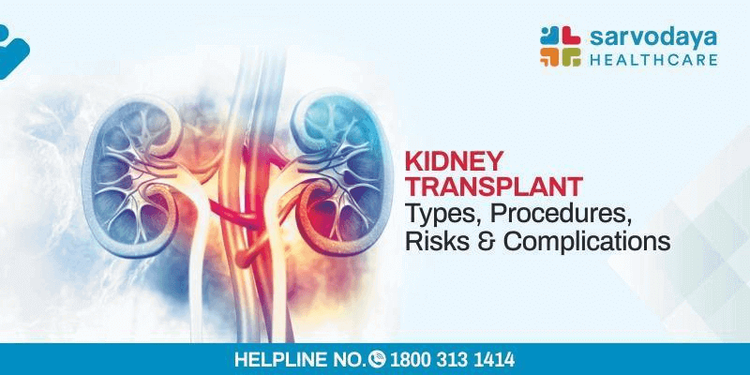
A Kidney Transplant is performed to replace a kidney that is not functioning properly with a healthy kidney, taken from a living or deceased donor. Kidney Transplant treatment is prescribed when both of the kidneys fail to function correctly leading to accumulation of harmful fluids & waste in the body. 

Kidneys are two bean-shaped organs located on each side of the spine near the upper abdomen. Usually, one kidney is a size of your fist and they work to eliminate waste from the blood through urine. Kidney transplant is recommended only when both the kidneys fail to perform this function, which leads to serious health issues. When the kidneys lose their functioning ability, waste accumulation in the body raises the blood pressure, which results in kidney failure. When the kidneys lose almost 90% of their ability, end-stage renal diseases occur.

Common causes of kidney failure include:

  • Chronic, uncontrolled high blood pressure
  • Chronic diabetes
  • Chronic glomerulonephritis 
  • Polycystic kidney diseases

Patients with end-stage kidney diseases urgently need to get waste removed from their bloodstream through a machine. This procedure is called dialysis, which helps the patients to survive for a few years but it certainly does not offer a permanent solution. In such cases, a kidney transplant treatment becomes necessary to stay alive. It is a procedure that requires multiple specialities to work together to ensure a successful transplant.

Types of Kidney Transplant

Deceased-donor kidney transplant: This is when the donor’s kidney is taken from a deceased person with the consent of their family or from their donor card. The kidney taken from the donor is then placed into a recipient’s body whose kidneys are no longer functioning properly and requires an urgent kidney transplantation.

Living-donor kidney transplant: This is when one kidney is taken from a living donor and placed into a recipient’s body whose kidneys are no longer functioning. A living donor can donate only one kidney which is enough to replace two failed kidneys. 

Pre-emptive kidney transplant: It is performed before initiating dialysis and found to deliver superior outcomes and greater patient survival rates. 

Procedure for Kidney Transplant

Kidney transplant is always scheduled in advanced if the donor’s kidney is being taken from a living donor. But in the case of a close matching deceased donor, one needs to be available to rush for the operation whenever the notice is given. 

Before performing the kidney transplant procedure, the patient’s blood sample is taken for an antibody test. When the test result is found negative crossmatch, the transplant procedure is performed. Usually, kidney transplant is performed under general anaesthesia which means the patient is put into a deep sleep during the whole procedure of surgery. The anaesthesia is usually injected into the patient’s body through an intravenous (IV) line in hand or arm.

Once anaesthesia is done, the surgeon will make an incision in the abdomen and place the donor kidney inside. Then arteries and veins from the kidney will be connected to the patient’s arteries and veins. This is done to make the blood to start flowing through the newly transplanted kidney. The new kidney’s ureter is also attached to the patient’s bladder so that they can urinate normally. The ureter is a tube that connects the kidney to the bladder.

Risks Factor of Kidney Transplant

Kidney transplantation is performed to treat advanced kidney disease and kidney failure. However, some kidney diseases may reoccur even after kidney transplant treatment.

Certain surgical health risks are associated with kidney transplant such as rejection of the donor organ, side effects of taking medications, a side effect of anaesthesia etc. These risks can be minimised by taking proper precautions and advice given by the doctor. Speak to your doctor about these risks to stay safe & healthy.

Complications of Kidney Transplant Surgery

Kidney transplant surgery carries certain complications which include:

  • Blockage of the ureter, which links the kidney to the bladder
  • Blood clots and bleeding
  • Surgical site infection
  • Failure or rejection of the newly transplanted kidney
  • An infection transmitted through the donated kidney
  • Heart attack and stroke
  • Death (very rare)

At Sarvodaya Hospital & Research Centre, Sec-8, Faridabad, we have all the subspecialized expertise in a single place with a focus to deliver the best treatment for you. In here, we work to deliver your test results quickly, appointments are scheduled accordingly, and the transplant care team works to deliver the best for you!

FAQs

A kidney transplant is a surgery where a healthy kidney replaces a failed one. It is recommended for patients with end-stage kidney disease or irreversible kidney failure.
Kidney transplants can be from a living donor or a deceased (cadaver) donor. At Sarvodaya Hospital, ABO incompatible kidney transplant is possible, that is, a kidney transplant can be done with a kidney from both a matched and an unmatched donor
Patients with severe kidney failure who are medically fit, infection-free, and able to take lifelong medicines are eligible. Consult the best kidney transplant doctor to understand in detail.
A healthy donor kidney is placed in the lower abdomen and connected to the blood vessels and the bladder. The patient’s own kidneys are usually left in place.
Risks include infection, bleeding, blood clots, kidney rejection, and side effects of anti-rejection medicines. Consult with a kidney doctor to avoid the risks and manage them timely.
Complications may include rejection, infections, high blood pressure, diabetes, or long-term medication-related effects.
Post a kidney transplant, hospital stay is usually 7–10 days. Most patients recover in 6–8 weeks with regular follow-ups.
Patients must take medicines regularly, follow a healthy diet, prevent infections, exercise moderately, and attend lifelong follow-ups.
Dr. Tanmay Pandya | Nephrology and Kidney Transplant  | Sarvodaya Hospital

Dr. Tanmay Pandya
HOD & Director - Nephrology & Renal Transplantation

Dr. Tanmay Pandya | Nephrology and Kidney Transplant  | Sarvodaya Hospital

Dr. Tanmay Pandya
HOD & Director - Nephrology & Renal Transplantation

Speak to Our Health Expert

Get reliable medical advice anytime, anywhere.

Related Blogs

Kidney Transplants 12 Frequently Asked Questions

Feb 16, 2023

Dr. Tanmay Pandya

Nephrology and Kidney Transplant

Kidney Transplants 12 Frequently Asked Questions

Read More Blog Read More Blog Read More

7 Expert Tips to Keep Your Kidneys Healthy

Feb 16, 2023

Dr. Tanmay Pandya

Nephrology and Kidney Transplant

7 Expert Tips to Keep Your Kidneys Healthy

Read More Blog Read More Blog Read More

Kidney Transplant: Things You Should Know About Post-Transplant

Feb 16, 2023

Kidney Disease: Symptoms And Treatment

Feb 16, 2023

View All

Recent Blogs

What Is Nuclear Medicine? Tests, Uses and Safety Explained

Mar 02, 2026

Dr. Swagat Dash

Nuclear Medicine & Molecular Theranostics

What Is Nuclear Medicine? Tests, Uses and Safety Explained

Read More Blog Read More Blog Read More

World Obesity Day 2026: Theme, Date & Importance

Feb 28, 2026

Dr. Piyush Kumar Agrawal

Minimally Invasive & Laparoscopic Surgery

World Obesity Day 2026: Theme, Date & Importance

Read More Blog Read More Blog Read More

World Hearing Day 2026: Theme, Date & Importance

Feb 28, 2026

Why the Colonoscopy Procedure Is Vital for Colon Cancer Prevention

Feb 25, 2026

Preventing Eye Strain from Screens: Expert Advice for Healthier Vision

Feb 24, 2026

Fibro Liver Scan: A Safe and Advanced Method for Liver Evaluation

Feb 23, 2026

View All

🖐Hi
E M E R G E N C Y